Pendant vs Wristband vs Watch: Which Medical Alarm to Choose
Once a family has settled on getting a medical alarm, a smaller question turns up: what should your parent actually wear? The same alarm button comes as a pendant on a cord, a band on the wrist, or a watch on the face. It sounds like a minor detail. It is not. The style decides whether the alarm gets worn at all, and an alarm in a drawer helps nobody.
None of the three is best for everyone. Each has a real strength and a real catch. This guide lays them out plainly so you can match the style to your parent, rather than guess.
Quick answer
A pendant is easiest to press and tends to give the most reliable fall detection, since it sits near the chest. A wristband stays put, never swings out of reach, and feels like a watch you forget you are wearing. A watch-style alarm looks ordinary and carries no stigma, which suits a parent who refuses to wear anything that says “alarm”. The right one is simply the one your parent will keep on all day. Most Australian providers will let you swap between styles, so you are not locked in.
How the three compare at a glance
| What matters most | Better fit |
|---|---|
| Easiest to find and press in a hurry | Pendant |
| Most reliable fall detection | Pendant, worn near the chest |
| Stays put and never gets left behind | Wristband |
| Looks ordinary, no stigma | Watch |
The pendant
The pendant is the classic medical alarm: one big button on a cord around the neck. It is the easiest to use of the three. There is no strap to fasten, nothing fiddly to do in the morning, and you can find the button by feel without your glasses. Because it hangs loose, it is comfortable for most people, and it suits anyone whose skin reacts to a band against the wrist.
It has a quiet advantage too. Fall detection generally works better from a pendant than from the wrist, because the device sits near the middle of the body where a fall is easier to read. That is the part that does not get mentioned in the brochure, and it matters if a fall could leave your parent unable to press the button themselves.
A pendant may suit someone who
- Wants the simplest possible button, with nothing to fasten
- Has arthritis or stiff hands that struggle with a watch buckle
- Would benefit most from reliable fall detection
The catch is that a pendant can swing out of the way, spin around, or tuck itself inside a cardigan, so it is not always right there when you reach for it. Some people also dislike the look of a cord around the neck, which is exactly where the other two styles come in.
The wristband
The wristband puts the same button on the wrist, fastened like a watch. It sits close to the body, so it does not swing about when your parent bends over to the garden or the oven. It is harder to lose, because it is always in the same spot, and it feels familiar. Most people have worn a watch their whole lives, so it slips into the routine without much thought.
That familiarity is the real selling point. The most common reason an alarm fails is that it gets taken off and left somewhere. A band that feels like an ordinary watch is more likely to stay on, day in and day out.
A wristband may suit someone who
- Is used to wearing a watch and barely notices one more
- Tends to put a pendant down and forget where it went
- Does a lot of bending, reaching and pottering about
The trade-off is fall detection. A device on the wrist sees a lot of arm movement, so wrist-based fall detection raises more false alarms and is generally less reliable than a pendant. For many families that is a fair swap for an alarm that is actually worn. For others, where falls are the main worry, it tips the choice back to a pendant.
The watch
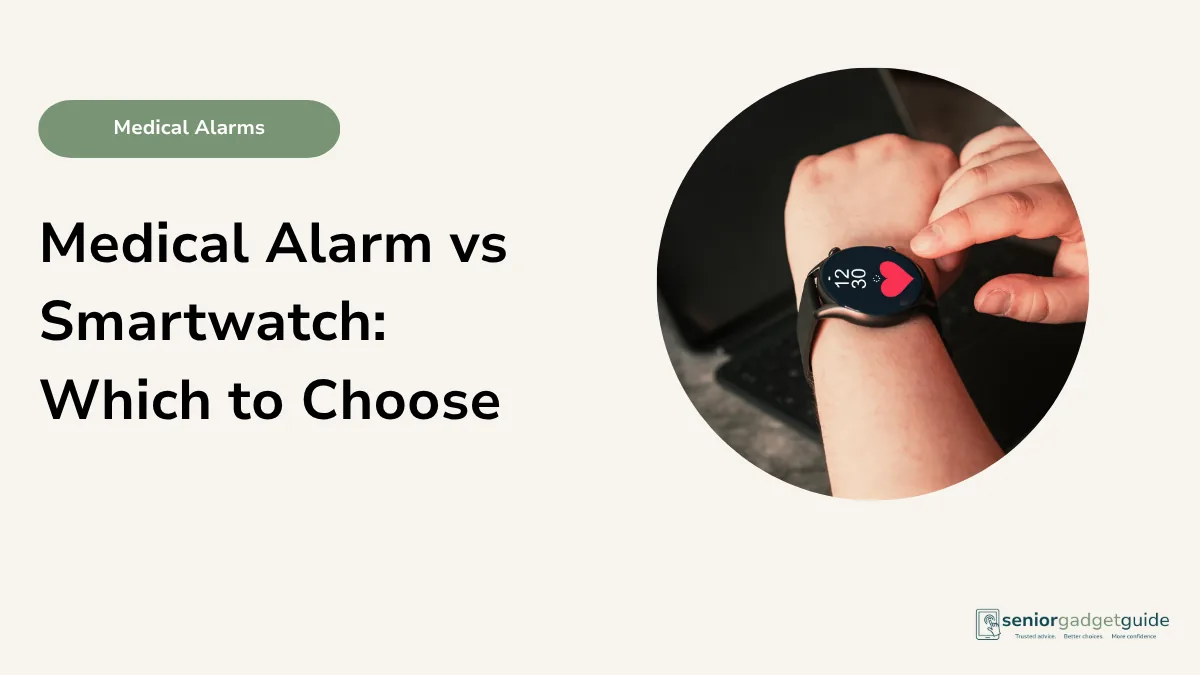
A watch-style alarm looks like a normal watch. It tells the time, and the help button is built in where no one would guess. For a parent who flatly refuses to wear anything that marks them out as needing help, this is often the difference between yes and no. There is no stigma, nothing for a visitor to notice, just a watch.
Some watch alarms add extras like step counts or reminders, though the help button stays the point. They do need charging, unlike a simple pendant that runs for a long time on its own. If this is the direction that appeals, our guide to the best medical alarm watches in Australia covers the specific options worth looking at.
A watch may suit someone who
- Will not wear an obvious alarm, but will happily wear a watch
- Is comfortable charging a device every day or two
- Likes the idea of a few extra features alongside the button
Where you wear it changes the fall detection
This is worth saying plainly, because it is the one technical point that affects safety. Fall detection works by sensing a sudden drop and stillness. From the chest, that pattern is clear, so a pendant reads falls more accurately. From the wrist, ordinary movements like setting down a cup or reaching for a shelf can look like a fall, so watches and wristbands tend to cry wolf more often, and can miss a real one.
If automatic fall detection is the main reason you are getting an alarm, lean towards a pendant. Our guide to the best fall detection alarms in Australia goes deeper on how that feature works and when it earns its keep.
What this means with Australian providers
The good news is that the main Australian providers offer more than one style, so you can match the wearer rather than the catalogue. MePACS, INS LifeGuard, VitalCALL and Tunstall all do a pendant, and several offer a wristband or a watch-style unit such as the MePACS Solo Connect or INS LifeGuard SafetyWatch. When you ring around, ask each one which styles they offer, whether fall detection is available on that style, and whether you can switch later at no cost if the first choice does not suit. It is also worth asking about funding: My Aged Care can often help with the monthly cost through the Support at Home program, and the NDIS or the Department of Veterans’ Affairs may help others.
Before you finish
Download the free Family Tech Safety Checklist to help check phone safety, passwords, scam messages, emergency contacts and medical alarm details.
In the end, it is the one that gets worn
Strip away the detail and it comes down to a single thing. The most effective alarm is the one your parent wears every day without resenting it. A clever pendant with the best fall detection in the country is useless on the hall table. A plain watch that never comes off will save the day.
So start with your parent, not the feature list. Ask what they would genuinely be happy to wear in the shower, in the garden, and to the shops. If they will tell you honestly, you have your answer. When you are ready to look at providers and plans, our guide to the best medical alarms in Australia is the next step.
FAQ: choosing a medical alarm style
Which style has the best fall detection?
A pendant, because it sits near the chest where a fall is easiest to read. Wrist-worn bands and watches see more arm movement, so their fall detection raises more false alarms.
Can my parent switch styles later?
Usually yes. Most providers can swap a pendant for a wristband, or the other way round, if the first choice does not suit. Ask when you sign up.
Are all three waterproof?
Pendants and wristbands from the main providers are made to be worn in the shower. Watch-style alarms vary, so check the rating before counting on it in the bathroom.
My parent says a pendant makes them look old. What now?
That is exactly when a watch-style alarm helps. It looks like an ordinary watch, so there is nothing to notice, and it is far more likely to be worn.
Does a watch alarm need charging?
Yes, usually every day or two, unlike a simple pendant that runs a long time on its own. If remembering to charge it could be a problem, a pendant or wristband is the safer pick.